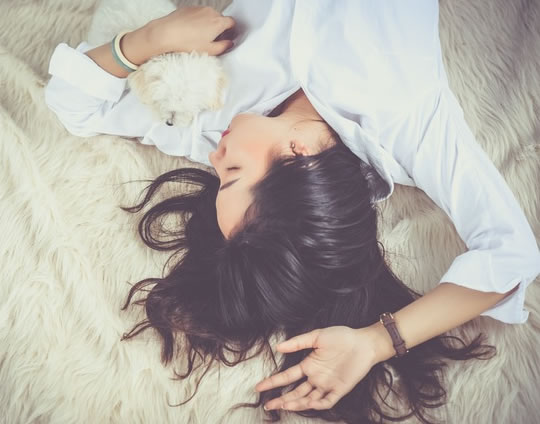
Why 75% of depressed people also report sleep problems like insomnia or difficulties falling asleep.
Keep reading with a Membership
• Read members-only articles
• Adverts removed
• Cancel at any time
• 14 day money-back guarantee for new members
Why 75% of depressed people also report sleep problems like insomnia or difficulties falling asleep.
The ‘melanopic display’ is able to reduce or increase the colour.
The ‘melanopic display’ is able to reduce or increase the colour.
Cyan — the greenish-blue colour that smartphones and other devices emit — could stop people sleeping properly.
People exposed to screens which emit less cyan felt more sleepy and had higher levels of the ‘sleep hormone’ melatonin in their system, new research finds.
However, those exposed to more cyan felt more awake and had lower levels of melatonin in their system.
The researchers developed a new type of visual display for their tests.
The ‘melanopic display’ is able to reduce or increase the amount of cyan, while keeping colours true.
Here are some different types of cyan:

Professor Rob Lucas, study co-author, said:
“This outcome is exciting because it tells us that regulating exposure to cyan light can influence how sleepy we feel.
Our study also shows how we can use that knowledge to improve the design of visual displays.
We built our melanopic display by adapting a data projector, but we would expect that this design could be applied to any type of display.
Such displays could, for example, help phone obsessed teenagers to fall asleep, or support alertness in people who need to use a computer at night.”
For the study, people watched a movie either with or without cyan.
Both movies looked the same as the technology balances out the other colours.
Melatonin levels were tested from saliva samples and people were asked how sleepy they felt afterwards.
Dr Annette Allen, the study’s first author, said:
“The new display design could actually have a wider benefit, as it seems that this technology also improves image appearance.
Like adding salt to food, we aren’t necessarily aware that it’s been done though we appreciate the effect.
Exploiting metamerism to regulate the impact of a visual display on alertness and melatonin suppression independent of visual appearance”
The study was published in the journal Sleep (Allen et al., 2018).
It almost doubled the amount of times that people awoke during the night.
It almost doubled the amount of times that people awoke during the night.
The blue light emitted by screens damages the length and quality of sleep, new research finds.
Screens that emit redder light, though, do not damage sleep in the same way.
Professor Abraham Haim, one of the study’s authors, said:
“The light emitted by most screens — computers, smartphones, and tablets — is blue light that damages the body’s cycles and our sleep.
The solution must be the use of the existing filters that prevent the emission of this light.”
Screens are particularly damaging to sleep if used at bedtime.
The screens suppress the secretion of melatonin, the hormone that helps control the body’s sleep-wake cycle.
One of the ways blue light damages sleep, the researchers found, was by interrupting how they body regulates its temperature.
Professor Haim said:
“Naturally, when the body moves into sleep it begins to reduce its temperature, reaching the lowest point at around 4:00 a.m.
When the body returns to its normal temperature, we wake up.
After exposure to red light, the body continued to behave naturally, but exposure to blue light led the body to maintain its normal temperature throughout the night — further evidence of damage to our natural biological clock.”
Blue light compared to red light almost doubled the amount of times that people awoke during the night.
Professor Haim said:
“Exposure to screens during the day in general, and at night in particular, is an integral part of our technologically advanced world and will only become more intense in the future.
However, our study shows that it is not the screens themselves that damage our biological clock, and therefore our sleep, but the short-wave blue light that they emit.
Fortunately various applications are available that filter the problematic blue light on the spectrum and replace it with weak red light, thereby reducing the damage to the suppression of melatonin.”
The study was published in the journal Chronobiology International (Green et al., 2017).
Two surveys hint at links between sleep position, personality and the strength of your relationship.
Two surveys hint at links between sleep position, personality and the strength of your relationship.
People who are more creative tend to sleep on their left-hand-side, a survey finds.
The survey also found that people who are more extraverted tend to sleep closer to their partners.
In fact, being in closer contact with your partner during sleep was related to having a better relationship.
12% of couples spend the night less than 1 inch apart.
Among these couples, 86% were happy with their relationship.
On the other hand, 2% slept more than 30 inches apart.
Among these couples the amount happy with their relationship dropped to 66%.
Touching was also an important factor, said Professor Richard Wiseman, who conducted the survey:
“One of the most important differences involved touching, with 94% of couples who spent the night in contact with one another were happy with their relationship, compared to just 68% of those that didn’t touch.”
It did not seem to make much difference in which direction couples were sleeping.
The most popular sleeping positions for couples were:
A previous survey for a budget hotel chain also examined the link between sleep position and personality.
It found that:
Speaking about his survey, Professor Wiseman said:
“This is the first survey to examine couples’ sleeping positions, and the results allow people to gain an insight into someone’s personality and relationship by simply asking them about their favourite sleeping position.”
The surveys were conducted to publicise a book and a budget hotel chain, respectively. In other words: take with a pinch of salt.
Insomnia is the most common complaint people have about their health.
Insomnia is the most common complaint people have about their health.
Insomnia is not just “all in your head”, neuroscientists have found.
For the first time, seven risk genes have been identified for insomnia.
This could be the first step in understanding the biological causes of insomnia.
It helps to show that insomnia is not — as is sometimes claimed — just a psychological condition.
Professor Van Someren, one of the study’s authors, said:
“As compared to the severity, prevalence and risks of insomnia, only few studies targeted its causes.
Insomnia is all too often dismissed as being ‘all in your head’.
Our research brings a new perspective. Insomnia is also in the genes.”
The study of 113,006 people identified seven genes involved in insomnia.
There was also a genetic overlap with two other related disorders: Restless Leg Syndrome and Periodic Limb Movement Disorder.
Genetic overlap was also seen with anxiety disorders, depression and neuroticism.
Dr Anke Hammerschlag, the study’s first author, said:
“This is an interesting finding, because these characteristics tend to go hand in hand with insomnia.
We now know that this is partly due to the shared genetic basis.”
The researchers also looked at the difference between insomnia in men and women.
Professor Danielle Posthuma, another study author, said:
“Part of the genetic variants turned out to be different.
This suggests that, for some part, different biological mechanisms may lead to insomnia in men and women.
We also found a difference between men and women in terms of prevalence: in the sample we studied, including mainly people older than fifty years, 33% of the women reported to suffer from insomnia.
For men this was 24%.”
The study was published in the journal Nature Genetics (Hammerschlag et al., 2017).
Send this survey to Human Resources so we can all have afternoon meetings, our faces adorned with sleep creases.
Send this survey to Human Resources so we can all have afternoon meetings, our faces adorned with sleep creases.
People who take short naps are happier than those who take long naps or no naps, a new survey finds.
The conclusion comes from a survey of over 1,000 people’s napping habits and their happiness.
66% of people who took naps under 30 minutes reported being happy.
This compared with 56% who took naps over 30 minutes and 60% who did not take naps.
Professor Richard Wiseman, who led the research, said:
“Previous research has shown that naps of under 30 minutes make you more focused, productive and creative, and these new findings suggest the tantalising possibility that you can also become happier by just taking a short nap.
Similarly longer napping is associated with several health risks and again, this is in line with our results.”
Professor Wiseman continued:
“A large body of research shows that short naps boosts performance.
Many highly successful companies, such as Ben & Jerry’s and Google, have installed dedicated nap spaces, and employees need to wake up to the upside of napping at work.”
The research also found that ‘only’ 11% were allowed to take naps at work.
The reason I scare-quote ‘only’ is that I’m surprised anyone is allowed to take a nap at work.
While companies may pay lip service to the nap, many prefer workers to stay at their desks all day and all night.
Whatever.
I suggest sending this research straight to Human Resources.
Every office in the country should shut down between 2 and 3pm so we can all get a little nap.
Then we could all have our 3pm meetings in pyjamas and dressing gowns with sleep creases across our faces.
Wouldn’t that be a great world to live in?
The study was presented at the 2017 Edinburgh International Science Festival by Professor Richard Wiseman.
The herb is central to the traditional home medicine of India called Ayurveda.
The herb is central to the traditional home medicine of India called Ayurveda.
Ashwagandha is a herb central to the traditional home medicine of India called Ayurveda.
Its Latin name is W. somnifera, meaning sleep-inducing, and it has been used for that purpose for centuries.
It is sometimes known as “Indian ginseng”.
Modern scientific studies have shown that crude powder of Ashwagandha helps to promote sleep.
Now, new research has revealed the active ingredient.
The Ashwagandha leaf is rich in triethylene glycol (TEG), which scientists have now found helps improve deep sleep.
Although this study was carried out on mice, no side-effects are generally found for humans.
The researchers hope that investigating TEG will revolutionise the treatment of insomnia.
Around 10-15% of the general population suffer from insomnia, rising to 30-60% in the elderly.
Insomnia is linked to many other problems, such as depression, obesity and cardiovascular disease, to name a few.
The active component of Ashwagandha, triethylene glycol (TEG), is commercially available and was found in the study to have the same effect as the crude powder.
The study was published in the journal PLOS ONE (Kaushik et al., 2017).
Organic Ashwagandha image from Shutterstock
A survey of 30,500 people in the UK across 4 years reveals dramatic mental and physical benefits.
A survey of 30,500 people in the UK across 4 years reveals dramatic mental and physical benefits.
Improving sleep quality leads to dramatic mental and physical health benefits, new research finds.
The boost from better sleep is equivalent to winning $250,000 on the lottery or taking an 8-week course in meditation.
Quality of sleep is more important than quantity, the researchers also found.
The conclusions come from a survey of 30,500 people in the UK across 4 years.
The researchers also found that lack of sleep led to greater use of sleep medications and worse emotional and physical states.
Dr Nicole Tang, the study’s first author, said:
“We are far from demonstrating a causal relationship, but the current findings suggest that a positive change in sleep is linked to better physical and mental wellbeing further down the line.
It is refreshing to see the healing potential of sleep outside of clinical trial settings, as this goes to show that the benefits of better sleep are accessible to everyone and not reserved for those with extremely bad sleep requiring intensive treatments.
An important next step is to look at the differences between those who demonstrate a positive and negative change in sleep over time, and identify what lifestyle factors and day-to-day activities are conducive to promoting sleep. Further research in this area can inform the design of public health initiatives.”
The study was published in the journal SLEEP (Tang et al., 2017).
Sleep has important effects on memory.
Sleep has important effects on memory.
Going to bed angry really does make it worse, new research finds.
Sleeping after making a fresh bad memory, can give that memory more strength.
Yunzhe Liu, the study’s first author, said:
“This study suggests that there is certain merit in this age-old advice: ‘Do not go to bed angry’.
We would suggest to first resolve (the) argument before… bed.”
In the study 73 students were purposefully given negative memories.
The results showed that it was much more difficult to suppress these negative memories after sleep.
The study may help in the treatment of post-traumatic stress disorder.
The study’s authors write:
“For example, sleep deprivation immediately after traumatic experiences may prevent traumatic memories from being consolidated… and thus provide the opportunity to block the formation of traumatic memories.”
The study was published in the journal Nature Communications (Liu et al., 2016).
Sleep image from Shutterstock
Smartphones and tablets can disturb sleep, but there is a quick fix.
Smartphones and tablets can disturb sleep, but there is a quick fix.
Using smartphones and tablets during the evening is thought to disturb sleep and even damage general health.
But now researchers have found that adequate light during the day can counter the effect.
Researchers at Uppsala University in Sweden found that evening readers of an illuminated ebook device (like the iPad) slept just as well as long as they were exposed to bright light during the day.
Ms Frida Rångtell, the study’s first author, said:
“Our main finding was that following daytime bright light exposure, evening use of a self-luminous tablet for two hours did not affect sleep in young healthy students.”
It is the blue light from e-readers, tablets and smartphones that is thought to cause sleep problems.
Previous research has found that using these devices close to bedtime disturbs sleep:
“When people read the iPad [before bed] they felt less sleepy in the evening, spent less time in rejuvenating REM sleep and their bodies produced less of the sleep-inducing hormone melatonin.
After eight hours sleep, the iPad readers were less alert and felt sleepier.”
The devices seem to disrupt the body’s natural circadian rhythms.
For the new research 14 people either read an iPad or paper book between 9pm and 11pm.
Dr Christian Benedict, study co-author, said:
“Our results could suggest that light exposure during the day, e.g. by means of outdoor activities or light interventions in offices, may help combat sleep disturbances associated with evening blue light stimulation.
Even if not examined in our study, it must however be kept in mind that utilizing electronic devices for the sake of checking your work e-mails or social network accounts before snoozing may lead to sleep disturbances as a result of emotional arousal.”
The other option, of course, is simply to read a real paper-and-ink book in the evening and avoid the luminous electronic devices.
The study was published in the journal Sleep Medicine (Rångtell et al., 2016).
Sleep image from Shutterstock
Join the free PsyBlog mailing list. No spam, ever.